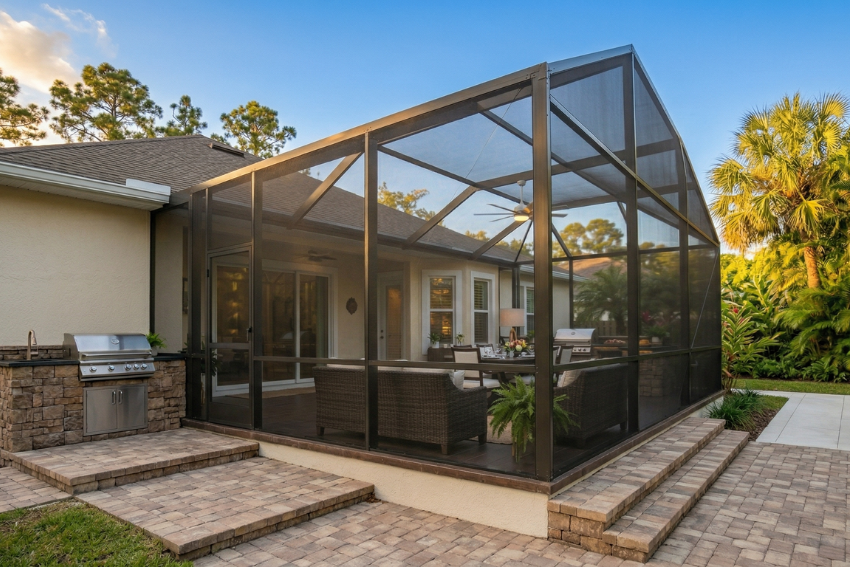
TL;DR
- A glass lanai enclosure transforms your existing patio into a fully enclosed, year-round room — clear views, natural light, and protection from Florida’s heat, rain, and insects
- Glass options matter: Low-E, insulated, and operational windows each perform differently in Northeast Florida’s climate, and the right choice depends on how you plan to use the finished space
- The smaller upgrade decisions you make at project time — door width, roof style, glass configuration — have an outsized impact on how livable and comfortable the finished space actually is
- Glass lanai enclosures deliver strong ROI at resale and add genuinely usable square footage to Northeast Florida homes
- Starting in August puts your finished enclosure ready before the holiday season; project timelines are typically eight to fourteen weeks from consultation to final inspection
Fall is the wrong time to start thinking about a glass lanai enclosure if you want it done before the holidays. August is the right time.
The timeline math is simple. A typical glass lanai enclosure project — from on-site consultation through design, permitting, material fabrication, installation, and final inspection — takes eight to fourteen weeks. Start in August, and you’re hosting Thanksgiving in a brand-new, glass-enclosed outdoor room. Wait until September, and you’re hoping everything aligns on the faster end. Wait until October, and you’re planning for next year.
But before you think about timing, you need to understand what you’re actually choosing. A glass lanai enclosure is the most complete outdoor living upgrade a Northeast Florida homeowner can make. And like any meaningful project, the decisions you get right at the start determine how much you love the finished space.
What Makes a Glass Lanai Enclosure Different
A glass lanai enclosure uses operational glass panels supported by an aluminum frame to fully enclose an existing covered patio or outdoor space. The glass walls can open for ventilation when the weather is cooperative and close completely during rain, wind, or the hottest stretches of summer — creating a protected, comfortable room that works in every season.
This is fundamentally different from a screen enclosure. Screen enclosures are excellent — they filter air, keep insects out, and give you a usable outdoor space at an accessible investment level. But a screen enclosure can’t protect you from rain, doesn’t manage heat, and can’t be furnished like a real room. Glass does all three.
The finished glass lanai enclosure feels like a natural extension of your home’s interior. Natural light fills the space from multiple angles. Views of the backyard stay clear and unobstructed. You can furnish it with a real dining table, properly upholstered chairs, or plants that actually thrive — because the space stays controlled rather than being at the mercy of Northeast Florida’s humidity swings, afternoon storms, and summer heat.
The Glass Options — What They Mean in Practice
Not all glass performs the same way in Florida’s climate. Choosing the right glass type is one of the most consequential decisions in a glass lanai enclosure project. Understanding your options before the design conversation puts you in a much better position.
Low-E Glass
Low-emissivity (Low-E) glass has a microscopically thin coating that dramatically reduces solar heat gain without significantly reducing the visible light coming through. In Florida’s climate — where managing heat is a much bigger challenge than managing cold — Low-E glass is one of the most effective performance upgrades available.
UF/IFAS research on energy-efficient windows and skylights in Florida identifies Solar Heat Gain Coefficient (SHGC) as the most important performance metric for Florida windows exposed to direct sunlight. Low-E glass with a low SHGC significantly reduces the amount of solar energy entering the space. The practical result: a glass lanai with Low-E glass feels noticeably cooler than one with standard glass on a hot August afternoon. You’re filtering the sun instead of fighting it.
Insulated Glass
Insulated glass uses two panes separated by an insulating air or gas gap that reduces heat transfer between the interior and exterior. For homeowners who want to connect their enclosed lanai to HVAC — either extending the home’s existing system or adding a ductless mini-split — insulated glass creates the thermal performance necessary to maintain comfortable temperatures year-round.
If the goal is a genuine four-season living space — somewhere you’d sit comfortably in a cool December with coffee, or in August with the air conditioning running — insulated glass is the right path.
Operational Windows
Operational windows are the glass panels that actually open. In Northeast Florida’s fall and mild winter months — October through April — the ability to open the glass and let a real breeze through is one of the most appreciated features homeowners mention after their project is complete.
The specific configuration matters more than most homeowners realize before they experience it. Sliding panels, bi-fold systems, and pocket windows each move differently and change how the space feels when open. The right choice depends on the enclosure’s footprint, the natural airflow patterns in your backyard, and how you picture actually using the space day-to-day.
Lifetime Enclosures’ glass enclosures overview for Northeast Florida covers the full range of glass configurations and what drives those decisions for local homes and climates.
The Upgrade Details That Change How You Use the Space
Glass type gets most of the attention in an enclosure conversation. But the smaller decisions at the design stage — the ones that feel like minor choices while you’re planning — often determine how much you love the finished space three years after the project is done.
Why Door Width Is Worth Getting Right the First Time
Standard enclosure doors are 36 inches wide. That’s functional. But for a glass lanai enclosure intended to serve as a real dining room, entertainment space, or everyday family room, a 42-inch wide door opening changes the experience in ways that are difficult to fully appreciate until you’ve lived with both.
A wider door means furniture moves in and out without frustration. Guests flow naturally between your home’s interior and the enclosed space without feeling like they’re navigating a utility entrance. A wheelchair, a stroller, or a large outdoor dining chair passes through easily. From a design standpoint, a 42-inch threshold gives the space the proportion of a room rather than a side passage.
The time to specify a wider door is during the original project — not afterward. Adding or modifying a door width on an existing aluminum frame means structural rework that’s significantly more involved and costly than incorporating it from the start. The difference in cost at project time is a fraction of what it would be as a retrofit. Getting it right when the frame is being built is the smart move — an upgrade that adds lasting everyday value for a marginal increase at the right moment.
Is a Glass Lanai Enclosure Worth the Investment?
For most Northeast Florida homeowners who go through with it — yes.
Glass lanai enclosures consistently rank among the strongest-return home improvements in Florida’s real estate market. National Association of Realtors research consistently identifies protected outdoor living spaces as among the top features buyers actively look for, particularly in markets where year-round outdoor use is a realistic expectation. In Northeast Florida, that’s every market.
A fully enclosed glass room is a meaningful step above a screen enclosure or open patio in terms of what it signals to buyers and how it affects perceived home value. Glass enclosures add true protected square footage — not just a covered patio, but a room you can photograph and describe as livable space. That matters at listing time.
The everyday return is harder to quantify but just as real. A glass lanai enclosure is used differently than an open patio — more often, through more months, and for more purposes. Morning routines move outside. Guests stay later because the space is genuinely comfortable. Kids have an outdoor room that works through fall and winter. The space becomes a fixture of how the home gets used, not an occasional feature that only works on perfect weather days.
Why August Is the Right Month to Start
The holiday calendar is a concrete deadline that makes the August timing case easy to understand. Start the consultation process now, and a finished glass lanai enclosure is ready for Thanksgiving, the December stretch, and winter break.
But scheduling is the other reason August matters. According to Florida enclosure contractors, the full project timeline from consultation to final inspection runs three to six weeks for the construction phase alone — and glass enclosures typically fall toward the longer end of that range because of glass fabrication lead times and the structural engineering documentation required for permitting.
Fall is also Lifetime Enclosures’ highest-demand window. Homeowners who spent the summer meaning to call start calling in September and October when the weather breaks and the urgency to get it done before winter arrives all at once. Project slots that are open in August fill quickly. Starting the conversation now means choosing from a full schedule rather than waiting for an opening.
Contact Lifetime Enclosures to schedule an on-site consultation — the design team will walk your existing space, discuss glass options, and give you an honest timeline for what a glass lanai enclosure would look like for your home and your backyard.
What to Expect: The Glass Enclosure Process
For a full walkthrough of the Lanai Enclosure or Conversion process, Lifetime Enclosures’ lanai conversions page covers it in detail. For glass enclosures specifically, here’s what the sequence looks like:
On-site consultation — The design team visits your home, walks the existing patio or covered space, and works through glass type, door configuration, roof style, and any structural considerations specific to your property.
Permitting and HOA coordination — Glass enclosures require building permits across all of Northeast Florida. Because of their weight and wind load characteristics, they typically also require structural engineering documentation in addition to standard permit materials. Lifetime Enclosures manages the entire permitting process and coordinates with HOA review boards for communities that require design approval.
Fabrication and material ordering — Glass panels — particularly insulated glass — have longer lead times than screen or vinyl materials. This stage runs in parallel with permitting to keep the overall project timeline moving.
Installation — The aluminum frame and glass panels are installed on-site. Most glass enclosure installations take several days depending on size, complexity, and weather.
Final inspection — The local building department verifies the completed structure against the approved permit. Once the inspection passes, the project is complete and the space is yours.
Frequently Asked Questions
What is the difference between a glass lanai enclosure and a sunroom? A glass lanai enclosure works within your existing patio’s footprint — using the existing slab, roofline, and framing — and adds glass panels and an aluminum frame to fully enclose the space. A sunroom is typically a full room addition that extends your home’s conditioned living envelope and involves a more significant construction scope. Glass lanai enclosures are faster, less disruptive, and generally more accessible in terms of project scale, while still delivering a fully protected, functional outdoor room.
What is “Florida Glass,” and is it actual glass? No — “Florida Glass” is not real glass, and the name creates genuine confusion. Florida Glass is a vinyl-coated fiberglass screen material used in the lower panels of screen enclosures to provide privacy and block dirt and debris. It looks more opaque than standard screen mesh, but it is a screen material, not a glass panel. A glass lanai enclosure uses actual operational glass — Low-E, insulated, or standard — not Florida Glass material. The two are entirely different products.
How long does a glass lanai enclosure project take from start to finish? Most glass lanai enclosure projects run eight to fourteen weeks from the initial on-site consultation through the final building inspection. Insulated glass panels carry longer fabrication lead times than standard glass, and structural engineering documentation — typically required for glass enclosures — adds time to the permitting stage. Homeowners who start the process in August consistently position their projects to finish before the holiday season.
Do I need a building permit for a glass lanai enclosure in Northeast Florida? Yes. Every glass lanai enclosure in Northeast Florida requires a building permit, covering all of Duval, Clay, St. Johns, Nassau, Putnam, and Flagler counties. Glass enclosures typically require structural engineering documentation in addition to standard permit materials because of their weight and wind load characteristics. Lifetime Enclosures handles all permitting and inspection coordination — homeowners are never asked to manage this themselves.
Why does door width matter, and what does a 42-inch door actually change? A 42-inch door opening changes everyday usability in ways that become clear once the space is in use. Furniture moves in and out easily. Guests transition naturally between the home’s interior and the enclosed space. The threshold feels proportionate to a room rather than a utility passage. The upgrade costs significantly less when incorporated during the original project than as a retrofit later — which is why it’s worth discussing at the design stage, not after the frame is built.
What glass type is best for keeping a glass lanai enclosure cooler in Florida’s heat? Low-E glass with a low Solar Heat Gain Coefficient (SHGC) is the most effective option for managing solar heat in Florida’s climate. Low-E glass reduces the amount of solar infrared energy entering the space while allowing visible light through — the practical result is a noticeably cooler enclosed lanai on hot afternoons. For full year-round climate control, pairing Low-E or insulated glass with a ductless mini-split system is the most complete solution.
How does a glass lanai enclosure affect resale value? Glass lanai enclosures add genuine protected square footage and create a livable outdoor room — both of which are among the most valued features in Northeast Florida’s buyer market. They consistently deliver strong returns at resale compared to open patios or basic screen enclosures, and they provide meaningful differentiation in competitive markets like St. Johns County, Jacksonville Beaches, and Ponte Vedra Beach.
Can I upgrade an existing screen enclosure to a glass lanai enclosure? In many cases, yes — depending on the existing aluminum frame’s condition, the slab, and the roofline. This is a conversation to have during the on-site consultation. Lifetime Enclosures evaluates existing structures and gives an honest assessment of whether the current frame can support a glass conversion or whether new framing is the better starting point.
Build Your Vision Before the Holidays
A glass lanai enclosure is the most complete transformation you can make to your home’s outdoor living space. A room that looks right, performs through every season, and adds real value to your property — both in daily life and at resale.
Lifetime Enclosures has been designing and building glass enclosures, vinyl enclosures, and screen enclosures across Northeast Florida since 1990. Every project starts with an on-site consultation and is backed by a team that manages every detail from permitting through final inspection.
August is the right time to start. Schedule your consultation today and build your vision before the holidays.